
Algorithmic Trading
Algorithmic Trading
Learn how trading rules become computer algorithms that analyse the market and execute trades automatically.
INTRODUCTION
What Is Algorithmic Trading?
Algorithmic trading, often called Algo Trading, is the process of using computer programs to analyse financial markets and execute trades automatically according to predefined rules.
Instead of relying on emotions or gut feelings, algorithmic trading follows objective logic. Every trade is based on conditions that have been planned, tested, and refined before live trading begins.
Large financial institutions have used algorithmic trading for decades. Today, retail traders can also build and use trading algorithms through platforms such as MetaTrader and TradingView.
Algorithmic trading is not about predicting the future. It is about executing a well-designed strategy with consistency and discipline.
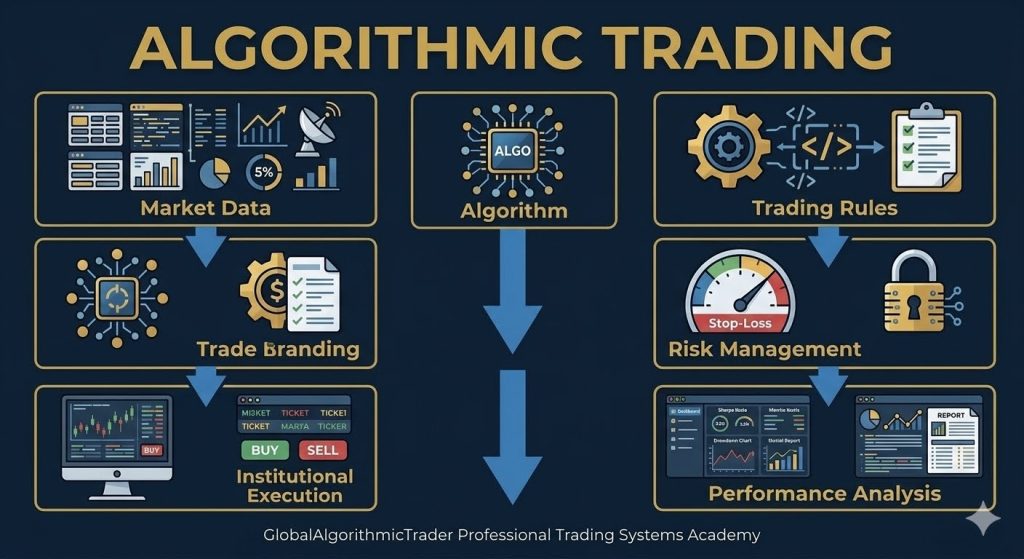
HOW ALGORITHMIC TRADING WORKS
Step 1 – Define the Rules
Every algorithm begins with a clear trading strategy.
Examples include:
- Buy when the 20 EMA crosses above the 50 EMA.
- Sell when RSI moves above 70.
- Exit when profit reaches 2:1 Risk-to-Reward.
- Stop trading after three consecutive losses.
Without clear rules, there is no algorithm.
Step 2 – Convert Rules into Code
The trading rules are translated into a programming language or automation platform.
Common options include:
- MQL4
- MQL5
- Pine Script
- Python
- APIs
The computer now understands exactly when to trade.
Step 3 – Backtest the Strategy
Before risking real money, test the algorithm using historical market data.
Backtesting helps answer important questions:
- Is the strategy profitable over time?
- How large is the drawdown?
- Which market conditions perform best?
- Does the strategy remain stable over several years?
Backtesting does not guarantee future performance, but it helps identify strengths and weaknesses before live deployment.
Step 4 – Trade Live
After successful testing, the algorithm can trade automatically.
Professional traders continue monitoring performance, reviewing results, and making improvements when necessary.
Automation does not eliminate responsibility—it requires ongoing supervision.

ADVANTAGES OF ALGORITHMIC TRADING
ADVANTAGES OF ALGORITHMIC TRADING
Consistent Execution
Every trade follows the same predefined rules.
Faster Decisions
Algorithms react much faster than manual traders.
Remove Emotional Bias
No fear, greed, or hesitation.
Backtesting
Strategies can be tested before live trading.
Multi-Market Trading
Monitor several instruments at the same time.
Continuous Optimisation
Performance can be measured and improved using real trading data.
DISADVANTAGES
Poor Strategy
A bad strategy remains a bad strategy, even when automated.
Programming Errors
Coding mistakes can produce unexpected trading results.
Market Changes
No algorithm performs well in every market condition.
Over-Optimisation
Strategies fitted too closely to historical data often fail in live markets.
Technical Failures
Internet outages, VPS failures, or broker issues can interrupt execution.
Ongoing Maintenance
Algorithms require monitoring and periodic updates.
ALGORITHMIC TRADING VS EXPERT ADVISORS
| Expert Advisor | Algorithmic Trading |
|---|
| Runs on MT4/MT5 | Broader concept covering many technologies |
| Usually MQL4/MQL5 | Can use Python, APIs, TradingView, C++, and more |
| Focused on trade execution | Covers research, execution, optimisation, and portfolio management |
| Suitable for retail traders | Used by both retail and institutional traders |
WHO SHOULD LEARN ALGORITHMIC TRADING?
Manual Traders
Automate proven trading strategies.
EA Users
Understand how trading logic works.
Developers
Create customised trading systems.
Quantitative Traders
Build data-driven investment models.
COMMON MISTAKES
❌ Automating an untested strategy.
❌ Ignoring risk management.
❌ Over-optimising backtests.
❌ Assuming automation removes all risk.
❌ Never reviewing performance.
❌ Chasing every new trading idea.
FAQ
Is algorithmic trading legal?
Yes. It is widely used by both retail and institutional traders.
Do I need programming knowledge?
Not always. Many platforms offer visual tools or ready-made solutions, but learning basic programming is a valuable long-term skill.
Can beginners learn algorithmic trading?
Yes, but they should first understand Forex trading, strategy development, and risk management.
Is algorithmic trading better than manual trading?
Neither is inherently better. Many successful traders combine manual analysis with algorithmic execution.
Can algorithmic trading guarantee profits?
No. The quality of the algorithm depends on the quality of the underlying trading strategy and risk management.
RELATED RESOURCES
Continue Learning
→ Portfolio Automation
→ Professional Trading Workflow
→ Expert Advisors
→ Quantitative Trading
→ Forex Academy
FREE DOWNLOAD
Algorithmic Trading Planning Worksheet
Includes:
✔ Strategy Rules Template
✔ Entry & Exit Planner
✔ Risk Management Checklist
✔ Backtesting Log
✔ Deployment Checklist
CTA
Good Algorithms Begin with Good Trading Rules
Successful algorithmic trading is not built on complicated code.
It begins with a simple, well-tested trading strategy, supported by disciplined risk management and continuous improvement.
Focus on building reliable trading systems before writing complex algorithms.
NTERNAL LINKS
Previous
Next
→ Portfolio Automation
- Forex Academy
- Professional Trading Workflow
- AI Trading
- Quantitative Trading
- Blog
Strategic recommendation:
Idea → Rules → Algorithm → Expert Advisor → Backtest → Live Trading → Continuous Improvement
Ready to Build a More Disciplined Trading Process?
Automation isn’t about removing traders—it is about removing inconsistency.
The most successful traders develop a clear trading strategy first, then gradually automate parts of their workflow to improve discipline, efficiency, and long-term consistency.
Take the next step by learning how to build your own automation journey.
Buttons
- Next: Trading Automation Roadmap →
- ← Back to Forex Trading Automation Overview