
📘 Book Progress: ■□□□□□□□□□ 10% Complete
Level 1 - Book 1 - Chapter 7
Leverage & Margin
How leverage works, how margin protects both you and your broker, and why smart traders use leverage carefully.
Estimated Reading Time: 12 - 15 Minutes
Introduction
One of the biggest attractions of the Forex market is leverage.
Unlike the stock market, Forex brokers allow traders to control much larger positions than the money they actually have in their trading account.
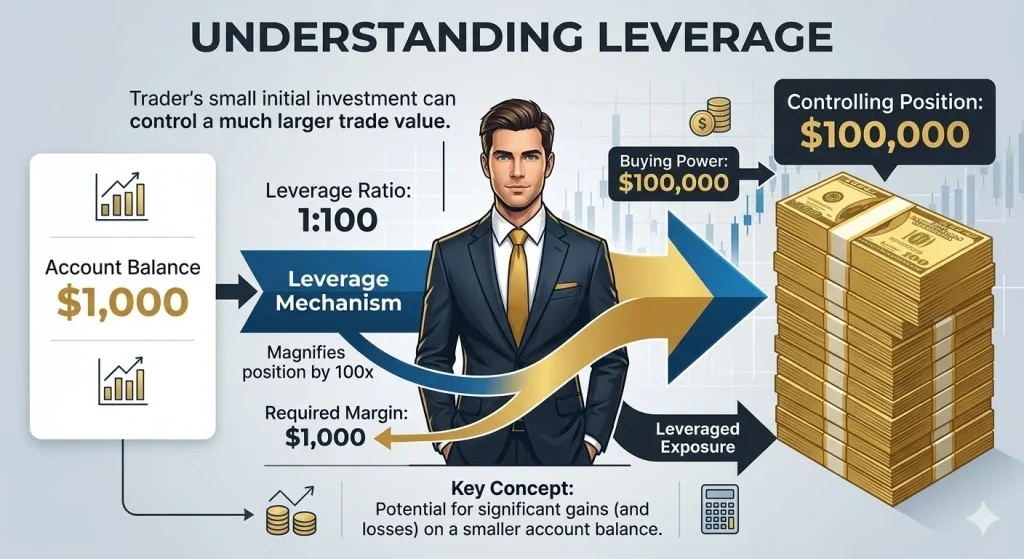
For example, with only $1,000, you may be able to control a trading position worth $100,000.
This sounds exciting.
However…
Leverage is also one of the biggest reasons why beginners lose money.
Professional traders do not become profitable because they use high leverage.
They become profitable because they manage risk.
In this chapter, you’ll learn how leverage works, how margin protects both you and your broker, and why smart traders use leverage carefully.
What Is Leverage?
Leverage is money temporarily provided by your broker, allowing you to control a larger trading position than your account balance.
Think of leverage as borrowing purchasing power.
Example:
You have:
Account Balance: $1,000
Your broker offers:
1:100 Leverage
This means every $1 controls $100.
Therefore:
$1,000 × 100 = $100,000
You can now trade one standard lot even though you only own $1,000.

Common Leverage Ratios
| Leverage | Controls |
|---|---|
| 1:10 | $10 for every $1 |
| 1:30 | $30 for every $1 |
| 1:50 | $50 for every $1 |
| 1:100 | $100 for every $1 |
| 1:200 | $200 for every $1 |
| 1:500 | $500 for every $1 |
| 1:1000 | $1,000 for every $1 |
Higher leverage does not make trading easier.
It simply allows larger positions.
What Is Margin?
Margin is the amount of your own money that is set aside to keep a trade open.
It is not a fee.
It is simply collateral held by your broker.
Example:
You open a trade worth:
$100,000
Required margin:
1%
You only need
$1,000
to control the position.
The remaining amount is temporarily provided through leverage.
Margin Explained Simply
Imagine buying a house.
You pay a deposit.
The bank finances the rest.
Forex margin works similarly.
Your margin is the deposit.
Your broker temporarily provides the remaining buying power.
Free Margin
Free Margin is the amount of money still available to open new trades.
Formula:
Free Margin = Equity − Used Margin
If your free margin becomes very low, you may not be able to open additional positions.
Margin Level
Margin Level measures the health of your trading account.
Formula:
Margin Level (%) = (Equity ÷ Used Margin) × 100
Higher margin levels mean lower risk.
Professional traders usually maintain a healthy margin level to avoid forced liquidations.
Margin Call
A Margin Call is a warning that your account no longer has sufficient equity to support your open positions.
Many brokers notify traders before this point, but the exact threshold varies.
Professional traders aim to avoid margin calls altogether through disciplined risk management.
Stop Out Level
If losses continue increasing, your broker may automatically close losing positions.
This is called a Stop Out.
Its purpose is to prevent your account balance from falling below the required margin.
Different brokers use different Stop Out levels.
Why High Leverage Is Dangerous
Many beginners think:
Higher leverage equals bigger profits.
While technically true…
It also means bigger losses.
Example:
Account Balance
$1,000
Leverage
1:1000
A small market movement against your position could wipe out a significant portion of your account if your position size is too large.
The problem is usually position sizing, not leverage itself.
Professional Traders Think Differently
Professionals rarely use all the leverage available.
Instead, they ask:
- How much am I willing to risk?
- Where is my stop loss?
- What lot size matches my risk?
- Does this trade fit my trading plan?
Leverage is simply a tool—not a strategy.
Recommended Leverage for Beginners
| Experience | Suggested Leverage |
|---|---|
| Beginner | 1:30 to 1:100 |
| Intermediate | 1:100 to 1:200 |
| Experienced | Depends on strategy and risk management |
More important than leverage is using sensible lot sizes and stop-loss placement.
Common Beginner Mistakes
❌ Using maximum leverage available
❌ Opening oversized trades
❌ Ignoring margin level
❌ Trading without stop losses
❌ Believing leverage guarantees profits
Key Takeaways
✅ Leverage increases buying power.
✅ Margin is collateral used to keep trades open.
✅ High leverage increases both potential profits and potential losses.
✅ Margin Calls warn of insufficient account equity.
✅ Stop Outs automatically close positions to protect the account.
✅ Successful traders focus on risk management rather than maximum leverage.
Frequently Asked Questions
What is leverage in Forex?
Leverage allows traders to control larger positions than their account balance by using funds temporarily provided by their broker.
Is higher leverage better?
Not necessarily. Higher leverage increases potential gains, but it also magnifies losses. It should be used with proper risk management.
What is margin?
Margin is the amount of your own money reserved as collateral to maintain an open trade. It is not a trading fee.
What happens during a Margin Call?
A Margin Call indicates that your account equity is becoming too low to support your open positions. If losses continue, positions may eventually be closed automatically.
Can beginners use high leverage safely?
Beginners are generally better served by conservative leverage combined with small lot sizes and disciplined risk management.
Continue Your Journey
- Chapter 1 – What is Forex Trading?
- Chapter 2 – The History of The Forex Market
- Chapter 3 – Currency Pairs
- Chapter 4 – How Forex Prices Move
- Chapter 5 – Reading Forex Quotes
- Chapter 6 – Pips, Points & Lot Sizes
- Chapter 7 – Leverage & Margin
- Chapter 8 – Types of Orders
- Chapter 9 – Bid, Ask & Spread
- Chapter 10 – Trading Sessions
Other Learning Lints:
- Forex Trading Automation OverviewPrevious Chapter
- AI Trading
- Algorithmic TradingNext Chapter
- Copy Trading
- Expert Advisor (EA)
- Gold Strategy
- Portfolio Automation
- Professional Trading Workflow
- Quantitative Trading
- Signal & Alert
- Trading Automation Roadmap
- Why Automate Trading
- Learn Forex
- Weekly Analysis
- Market Outlook
- Gold Outlook
- Blog
Automation Insight
Professional Expert Advisors (EAs) monitor margin level, free margin, and account equity before opening new trades. If available margin is too low, the EA will reject the trade instead of exposing the account to unnecessary risk.