
Professional Trading Workflow
Discover the structured workflow professional automated traders use to research, test, deploy, monitor, and continuously improve their trading systems.
Professional Trading Workflow
Successful trading is not about predicting the market. It's about following a disciplined process every single day.
INTRODUCTION
Trading Is a Business, Not a Gamble
Many beginner traders focus almost entirely on finding the “perfect entry.”
Professional traders think differently.
They understand that a successful trade is only one small part of a much larger process.
Consistent results come from repeating a structured workflow—preparing before the market opens, executing according to a plan, managing risk, reviewing performance, and continuously improving.
Whether you trade manually, use Expert Advisors, or build algorithmic trading systems, a professional workflow provides the discipline needed for long-term success.
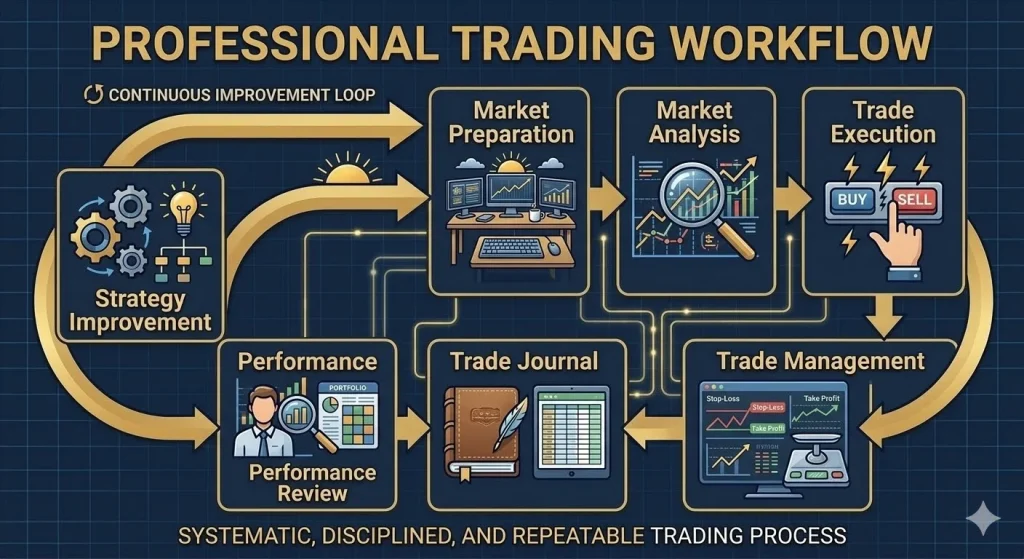
THE PROFESSIONAL TRADING WORKFLOW
Step 1 – Market Preparation
Every trading day begins before the first trade.
Professional traders prepare by reviewing:
- Economic calendar
- Major news events
- Previous trading performance
- Market sentiment
- Important support and resistance levels
- Trading session schedule
Preparation reduces surprises and improves decision-making.
Step 2 – Market Analysis
Once prepared, traders analyse the market using their trading plan.
Typical analysis includes:
- Trend direction
- Market structure
- Price action
- Technical indicators
- Volatility
- Risk-to-reward opportunities
The goal is to identify high-quality setups—not to force trades.
Step 3 – Trade Execution
Only when all trading rules are satisfied should a trade be entered.
Professional traders follow predefined rules for:
- Entry price
- Position size
- Stop-loss placement
- Take-profit target
There is no guessing or emotional decision-making.
Step 4 – Trade Management
After entering a trade, successful traders manage risk rather than constantly changing their plan.
Management may include:
- Moving Stop Loss to Breakeven
- Partial profit taking
- Trailing Stop adjustments
- Closing trades before major news
- Monitoring open risk
Avoid making impulsive changes based on emotions.
Step 5 – Trading Journal
Every completed trade provides valuable information.
Record:
- Entry reason
- Exit reason
- Screenshots
- Profit or loss
- Emotions experienced
- Lessons learned
The journal becomes one of your most valuable learning tools.
Step 6 – Performance Review
At the end of each week or month, review your trading performance.
Measure:
- Win rate
- Average reward-to-risk ratio
- Profit factor
- Maximum drawdown
- Number of trades
- Rule-following discipline
The objective is continuous improvement, not perfection.
Step 7 – Strategy Improvement
Markets evolve.
Professional traders regularly evaluate whether their strategy still performs well.
Possible improvements include:
- Refining entry rules
- Improving risk management
- Optimising automation settings
- Backtesting updates
- Removing unnecessary complexity
Never change a strategy after only a few losing trades. Use data, not emotions.

DAILY, WEEKLY & MONTHLY ROUTINE
| Frequency | Tasks |
|---|
| Daily | Prepare, Analyse, Execute, Journal |
| Weekly | Review trades, Calculate statistics, Identify mistakes |
| Monthly | Evaluate strategy performance, Update goals, Optimise systems |
WHY A WORKFLOW MATTERS
WHY A WORKFLOW MATTERS
Consistency
A repeatable process produces repeatable results.
Better Decisions
Preparation reduces emotional reactions.
Continuous Learning
Journals help identify strengths and weaknesses.
Stronger Risk Management
Every trade follows the same rules.
Easier Automation
A structured workflow can be automated step by step.
Professional Mindset
Treat trading like a business rather than entertainment.
COMMON MISTAKES
❌ Trading without a plan.
❌ Ignoring the economic calendar.
❌ Skipping trade journaling.
❌ Changing strategies too frequently.
❌ Focusing only on profits instead of process.
❌ Never reviewing performance.
WHO SHOULD USE THIS WORKFLOW?
Beginner Traders
Build good habits from day one.
Manual Traders
Improve consistency and discipline.
Automated Traders
Monitor and refine trading systems.
Professional Traders
Scale and optimise multiple strategies efficiently.
FAQ
Do professional traders trade every day?
Not necessarily. Many professionals wait patiently for high-quality setups rather than forcing trades.
Is a trading journal really necessary?
Yes. Without records, it is difficult to identify recurring mistakes or measure improvement.
How often should I review my strategy?
A weekly review is recommended, with a more comprehensive monthly performance analysis.
Can automation replace a trading workflow?
No. Automation assists execution, but planning, monitoring, and improvement remain essential.
What is the most important part of the workflow?
Discipline. A simple workflow followed consistently is usually more effective than a complex workflow followed inconsistently.
RELATED RESOURCES
Continue Learning
→ Copy Trading
→ AI Trading
→ Portfolio Automation
→ Forex Academy
→ Weekly Gold Outlook
FREE DOWNLOAD
Professional Trading Workflow Checklist
Includes:
✔ Daily Pre-Market Checklist
✔ Trade Execution Checklist
✔ Trading Journal Template
✔ Weekly Review Sheet
✔ Monthly Performance Tracker
Button:
Download Free Checklist
CTA
Build Better Habits Before Better Strategies
Successful traders are not defined by one great trade.
They are defined by consistently following a disciplined process, managing risk responsibly, and continuously improving over time.
A professional workflow transforms trading from a series of random decisions into a repeatable business process.
Buttons
Next: Copy Trading →