
📘 Book Progress: ■□□□□□□□□□ 10% Complete
Level 1 - Book 1 - Chapter 6
Pips, Points & Lot Sizes
Understanding pips, points, and lot sizes is essential because they determine how much money you gain or lose on every trade.
Estimated Reading Time: 10 - 12 Minutes
Introduction
One of the biggest mistakes beginners make is focusing only on whether the market goes up or down.
Professional traders think differently.
They ask:
- How many pips can I make?
- How much am I risking?
- What lot size should I trade?
- Is this trade worth taking?
Understanding pips, points, and lot sizes is essential because they determine how much money you gain or lose on every trade.
Without understanding these concepts, it is impossible to manage risk effectively or build a profitable trading strategy.
What Is a Pip?
A pip stands for Percentage in Point and is the standard unit used to measure price movement in the forex market.
For most currency pairs:
1 Pip = 0.0001
Example:
EUR/USD moves from
1.1800
to
1.1801
That is 1 pip.
If it moves to
1.1815
that’s 15 pips.

Japanese Yen Exception
Currency pairs involving the Japanese Yen use two decimal places.
Example:
USD/JPY
145.50
to
145.51
equals
1 pip
What Is a Point?
Modern brokers usually display an extra decimal place.
Instead of
1.1800
they show
1.18005
That final decimal is called a point (or pipette).
Example:
Price moves
1.18005
to
1.18015
= 10 points = 1 pip
Therefore:
- 10 Points = 1 Pip
- 100 Points = 10 Pips
Many MT4 and MT5 platforms measure stop losses and take profits in points, so it’s important to know the difference.
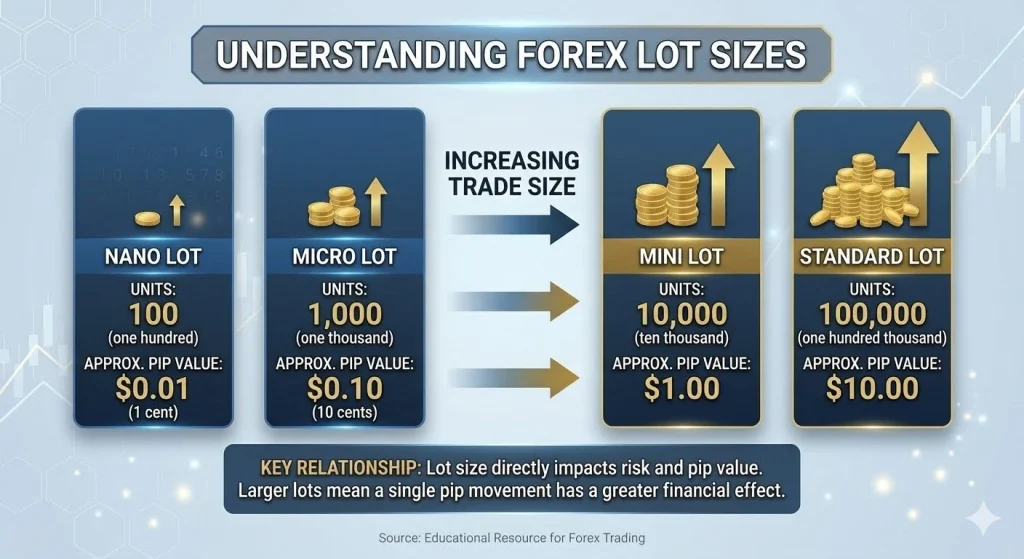
Understanding Lot Sizes
A lot is the amount of currency you trade.
Different lot sizes represent different trade volumes.
| Lot Type | Units |
|---|---|
| Standard Lot | 100,000 |
| Mini Lot | 10,000 |
| Micro Lot | 1,000 |
| Nano Lot | 100 |
Most beginners start with Micro Lots because they reduce risk while learning.
Why Lot Size Matters
Imagine EUR/USD moves 100 pips.
Different lot sizes produce different profits or losses.
| Lot Size | Approximate Value per Pip |
|---|---|
| Standard | $10 |
| Mini | $1 |
| Micro | $0.10 |
| Nano | $0.01 |
A 100-pip move would approximately equal:
- Standard Lot ≈ $1,000
- Mini Lot ≈ $100
- Micro Lot ≈ $10
- Nano Lot ≈ $1
These values vary slightly depending on the currency pair and account currency, but they provide a useful illustration.
Why Beginners Blow Their Accounts
Many beginners think:
“Bigger lot size means bigger profits.”
This is true.
But it also means:
Bigger losses.
For example:
A trader with a $500 account opens a 1 Standard Lot position.
A market movement of only 50 pips against them could result in a loss of around $500, effectively wiping out the account.
Professional traders choose lot sizes based on risk—not emotion.
Position Sizing
Professional traders decide how much to risk first, then calculate the appropriate lot size.
Example:
Account Balance
$2,000
Maximum Risk
2%
Maximum Loss
$40
If the stop loss is 40 pips, the lot size should be selected so that a 40-pip loss equals about $40.
This is known as position sizing, and it is one of the most important skills in trading.
Common Beginner Mistakes
❌ Trading oversized positions
❌ Ignoring stop-loss distance
❌ Chasing profits with larger lot sizes
❌ Confusing pips with points
❌ Believing leverage alone determines profits
Key Takeaways
✅ A pip measures price movement.
✅ Most forex pairs use four decimal places.
✅ JPY pairs use two decimal places for pips.
✅ A point is one-tenth of a pip on five-decimal pricing.
✅ Lot size determines trade volume.
✅ Proper position sizing is essential for long-term success.
Frequently Asked Questions
What is a pip in Forex?
A pip is the standard unit used to measure price movement in the forex market. For most currency pairs, one pip equals 0.0001.
What is the difference between a pip and a point?
On most modern trading platforms, 10 points equal 1 pip. Points represent the smallest quoted price movement.
Which lot size should beginners use?
Most beginners should start with Micro Lots (0.01) to keep risk low while learning.
Does a bigger lot size mean more profit?
Yes, but it also means greater potential losses. Lot size should always be based on your risk management plan.
Why is position sizing important?
Position sizing helps ensure that each trade risks only a small percentage of your account, making your trading more consistent and sustainable.
Continue Your Journey
- Chapter 1 – What is Forex Trading?
- Chapter 2 – The History of The Forex Market
- Chapter 3 – Currency Pairs
- Chapter 4 – How Forex Prices Move
- Chapter 5 – Reading Forex Quotes
- Chapter 6 – Pips, Points & Lot Sizes
- Chapter 7 – Leverage & Margin
- Chapter 8 – Types of Orders
- Chapter 9 – Bid, Ask & Spread
- Chapter 10 – Trading Sessions
Other Learning Lints:
- Forex Trading Automation OverviewPrevious Chapter
- AI Trading
- Algorithmic TradingNext Chapter
- Copy Trading
- Expert Advisor (EA)
- Gold Strategy
- Portfolio Automation
- Professional Trading Workflow
- Quantitative Trading
- Signal & Alert
- Trading Automation Roadmap
- Why Automate Trading
- Learn Forex
- Weekly Analysis
- Market Outlook
- Gold Outlook
- Blog
Automation Insight
Every professional Expert Advisor (EA) calculates position size before opening a trade. Instead of using a fixed lot size, advanced systems determine the lot based on account balance, stop-loss distance, and the percentage of capital the trader is willing to risk.