
📘 Book Progress: ■□□□□□□□□□ 10% Complete
Level 1 - Book 1 - Chapter 10
Understanding Bid, Ask & Spread
Understanding Bid, Ask, and Spread will help you understand how brokers execute trades and why trading costs are an important part of every strategy.
Estimated Reading Time: 12 - 15 Minutes
Introduction
Every trader notices something unusual after opening their very first Forex trade.
You click Buy.
The trade opens successfully.
But instead of showing $0.00 profit, it immediately shows a small floating loss.
Many beginners think something is wrong.
Nothing is wrong.
This happens because every Forex market has two prices, not one.
Understanding Bid, Ask, and Spread will help you understand how brokers execute trades and why trading costs are an important part of every strategy.
Understanding the Bid Price
The Bid Price is the highest price that buyers are currently willing to pay.
If you already own a currency pair and want to sell it, your trade will close at the Bid Price.
Think of it as:
Bid = Sell Price
Example
EUR/USD
Bid
1.18500
If you close your Buy trade, it will be sold at 1.18500.
Understanding the Ask Price
The Ask Price is the lowest price sellers are willing to accept.
When you open a Buy trade, you buy at the Ask Price.
Think of it as:
Ask = Buy Price
Example
EUR/USD
Ask
1.18520
If you open a Buy trade, your entry price is 1.18520.
What Is the Spread?
The Spread is the difference between the Ask Price and the Bid Price.
Formula:
Spread = Ask Price − Bid Price
Example
| Bid | Ask |
|---|---|
| 1.18500 | 1.18520 |
Spread:
0.00020 = 2 pips
This spread represents one of the costs of trading.
Why Does Every Trade Start Negative?
Imagine you buy EUR/USD.
| Price | Value |
|---|---|
| Bid | 1.18500 |
| Ask | 1.18520 |
Your Buy trade opens at 1.18520.
If you immediately close it, the broker buys it back at 1.18500.
That difference of 2 pips becomes your initial floating loss.
The market must first move enough to cover the spread before your trade becomes profitable.
Fixed vs Floating Spreads
Different brokers offer different spread models.
| Fixed Spread | Floating Spread |
|---|---|
| Usually stays the same | Changes with market conditions |
| Predictable trading costs | Often lower during normal markets |
| May be wider overall | Can widen significantly during volatile events |
Many ECN and Raw Spread accounts use floating spreads together with a separate commission.
Why Do Spreads Change?
Spreads usually become wider during periods of uncertainty or low liquidity.
Common situations include:
- Major economic news releases
- Interest rate announcements
- Market opening and closing periods
- Public holidays
- Low trading activity
- Unexpected geopolitical events
Professional traders often avoid opening new positions when spreads widen dramatically.
How Spread Affects Your Trading
Suppose two traders both make 20 pips on the same strategy.
| Trader | Spread | Net Profit |
|---|---|---|
| Trader A | 1 pip | 19 pips |
| Trader B | 4 pips | 16 pips |
Over hundreds of trades, even small differences in spread can have a significant impact on long-term performance.
Choosing the Right Broker
When comparing brokers, don’t focus only on low spreads.
Also consider:
- Regulation
- Order execution quality
- Slippage
- Trading commissions
- Platform stability
- Customer support
The cheapest spread isn’t always the best overall trading environment.
Common Beginner Mistakes
❌ Thinking the broker made a mistake because the trade starts negative.
❌ Ignoring spread when calculating risk-to-reward.
❌ Trading during major news events without checking current spreads.
❌ Choosing a broker based only on the advertised minimum spread.
❌ Backtesting strategies without including realistic spread costs.
Key Takeaways
✅ Every Forex market has two prices.
✅ Bid is the selling price.
✅ Ask is the buying price.
✅ Spread is the difference between Bid and Ask.
✅ Every trade begins by paying the spread.
✅ Spread is one of the ongoing costs of trading.
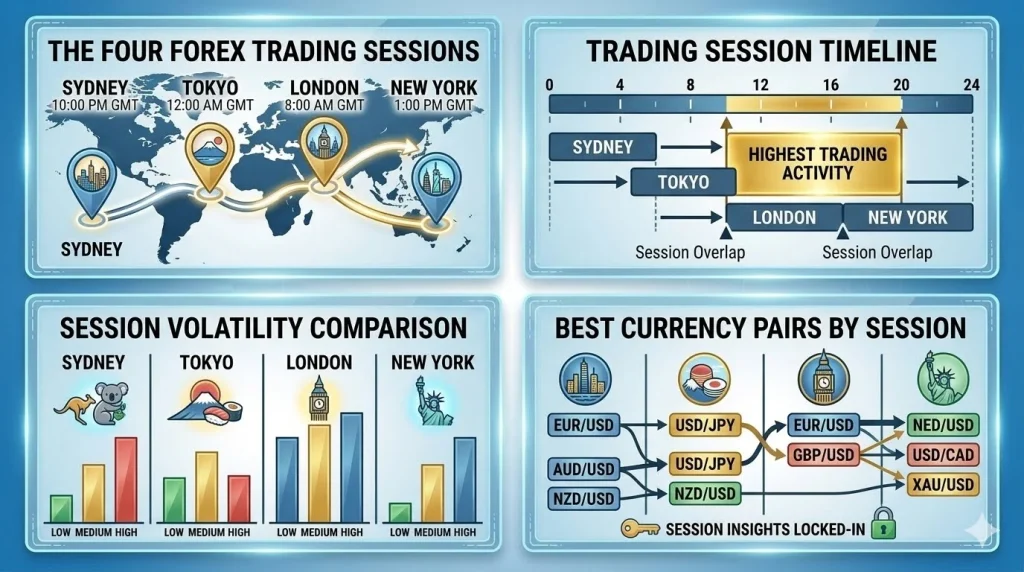
✔ There are four major trading sessions.
✔ London and New York are generally the most active sessions.
✔ Different currency pairs are more active during different sessions.
✔ Choosing the right session can improve trade quality.
Frequently Asked Questions
Why does my trade show a loss immediately after opening?
Because Buy trades open at the Ask price but would close at the Bid price. The difference between the two prices is the spread.
Is the spread the same for every currency pair?
No. Major currency pairs usually have lower spreads than minor or exotic pairs because they are traded more actively.
Why do spreads increase during news events?
Major news releases increase uncertainty and volatility. Liquidity providers often widen spreads to manage the increased market risk.
Are lower spreads always better?
Lower spreads generally reduce trading costs, but broker regulation, execution quality, commissions, and reliability are equally important.
Do all brokers charge spreads?
Almost all Forex brokers include a spread. Some accounts offer extremely low spreads but charge a separate trading commission.
Continue Your Journey
- Chapter 1 – What is Forex Trading?
- Chapter 2 – The History of The Forex Market
- Chapter 3 – Currency Pairs
- Chapter 4 – How Forex Prices Move
- Chapter 5 – Reading Forex Quotes
- Chapter 6 – Pips, Points & Lot Sizes
- Chapter 7 – Leverage & Margin
- Chapter 8 – Types of Orders
- Chapter 9 – Bid, Ask & Spread
- Chapter 10 – Trading Sessions
Other Learning Lints:
- Forex Trading Automation OverviewPrevious Chapter
- AI Trading
- Algorithmic TradingNext Chapter
- Copy Trading
- Expert Advisor (EA)
- Gold Strategy
- Portfolio Automation
- Professional Trading Workflow
- Quantitative Trading
- Signal & Alert
- Trading Automation Roadmap
- Why Automate Trading
- Learn Forex
- Weekly Analysis
- Market Outlook
- Gold Outlook
- Blog
Automation Insight
Every professional trading robot evaluates the spread before opening a position. Even a profitable strategy can become unprofitable if trading costs are too high. That’s why many Expert Advisors include a maximum spread filter to avoid entering trades during unfavorable market conditions.