
📘 Book Progress: ■□□□□□□□□□ 10% Complete
Level 1 - Book 1 - Chapter 3
Currency Pairs
Learn how currency pairs work, why currencies are always traded in pairs, and how to identify the major, minor, and exotic pairs traded in the Forex market.
Estimated Reading Time: 10 Minutes
Chapter Information
Item
Deatils
Level
Level 1
Book
Book1 - Forex Fundamentals
Chapter
Chapter 2
Difficulty
Beginner
Reading Time
18 Mnitues
Practical Excercise
Yes
Quiz
5 Questions
Donload
None
Why Currency Pairs Matter
Every Forex trade involves buying one currency while simultaneously selling another. Unlike stocks, where you buy shares of a single company, the Forex market always compares the value of one currency against another.
Understanding currency pairs is one of the most important foundations of Forex trading. Before you can analyse charts, place trades, or automate trading strategies, you must understand what each currency pair represents and how exchange rates are quoted.
In this chapter, you’ll learn how currency pairs are structured, the different categories of currency pairs, and why some pairs are more actively traded than others.
Learning Objectives
After completing this chapter, you will be able to:
✓ After completing this chapter, you will be able to:
✔ Understand why currencies are traded in pairs.
✔ Identify the base currency and quote currency.
✔ Differentiate between major, minor, and exotic currency pairs.
✔ Recognise the most commonly traded currency pairs.
✔ Understand why liquidity and volatility differ between pairs.
Table of Contents
This improves user experience and SEO.
- Introduction
- Before Money Existed
- The Birth of Modern Currencies
- The Gold Standard
- The Bretton Woods System
- The End of Fixed Exchange Rates
- The Birth of Modern Forex
- Why the Forex Market Never Sleeps
In Real Life - Professional Trader’s Insight
- Common Beginner Mistakes
- Chapter Summary
- Homework
- Knowledge Check
- Frequently Asked
- Questions
- Continue Your Journey
1. What Is a Currency Pair?
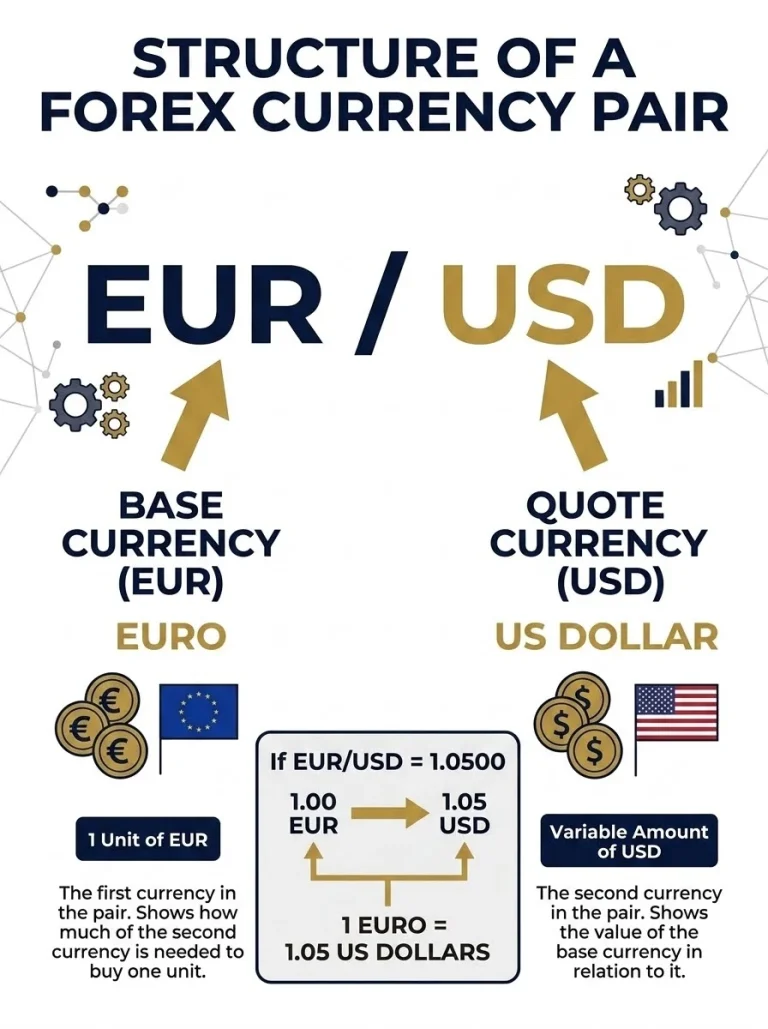
A currency pair represents the exchange rate between two different currencies.
For example:
EUR/USD = 1.1800
This means:
1 Euro (EUR) is worth 1.1800 US Dollars (USD).
The first currency is called the Base Currency.
The second currency is called the Quote Currency.
Whenever you buy EUR/USD, you are:
- Buying Euros
- Selling US Dollars
Whenever you sell EUR/USD, you are:
- Selling Euros
- Buying US Dollars
2. Major Currency Pairs
Major pairs are the most actively traded currency pairs in the world.
Characteristics
- Highest trading volume
- Lowest spreads
- Highest liquidity
- Most suitable for beginners
| Currency Pair | Description |
|---|---|
| EUR/USD | Euro vs US Dollar |
| GBP/USD | British Pound vs US Dollar |
| USD/JPY | US Dollar vs Japanese Yen |
| USD/CHF | US Dollar vs Swiss Franc |
| AUD/USD | Australian Dollar vs US Dollar |
| USD/CAD | US Dollar vs Canadian Dollar |
| NZD/USD | New Zealand Dollar vs US Dollar |

3. Minor Currency Pairs
Minor currency pairs do not include the US Dollar but still consist of two major currencies.
Examples include:
- EUR/GBP
- EUR/JPY
- GBP/JPY
- EUR/AUD
- AUD/NZD
Characteristics
- Moderate liquidity
- Moderate spreads
- Suitable for traders with some experience
4. Exotic Currency Pairs
Exotic pairs combine one major currency with the currency of an emerging or developing economy.
Examples:
- USD/SGD
- USD/TRY
- USD/ZAR
- EUR/THB
Characteristics
- Lower liquidity
- Higher spreads
- Larger price swings
- Higher trading risk
Beginners should generally avoid trading exotic pairs until they have more experience.
5. Comparison Table
6. Start with One or Two Currency Pairs
Professional traders rarely monitor dozens of currency pairs.
Instead, they specialise in one or two highly liquid pairs and learn how those markets behave under different market conditions.
7. Trading Too Many Currency Pairs
Many beginners believe that watching twenty or thirty charts increases trading opportunities.
In reality, it usually creates confusion, inconsistent analysis, and emotional decision-making.
Master one market before expanding your watchlist.
8. Key Takeaway
Understanding currency pairs is the foundation of Forex trading.
Before learning technical analysis or building automated trading systems, you must understand:
- Base currency
- Quote currency
- Exchange rates
- Major pairs
- Minor pairs
- Exotic pairs
A strong understanding of these concepts will make every future lesson much easier.
⭐ Professional Trader’s Insight
Markets are built on confidence.
Throughout history, currencies have changed because economies, governments, and public confidence have changed.
Professional traders don’t simply study charts—they also understand the economic systems that drive long-term market behaviour.
Common Beginner Mistakes
❌ Thinking Forex was invented for online trading.
❌ Believing currency prices move randomly.
❌ Ignoring major historical events.
❌ Underestimating the role of central banks.
❌ Focusing only on technical analysis while ignoring economic fundamentals.
Chapter Summary
- Why currencies are always traded in pairs
- Base currency and quote currency
- Major currency pairs
- Minor currency pairs
- Exotic currency pairs
- Why beginners should focus on major pairs
Frequently Asked Questions
Why are currencies traded in pairs?
Because one currency’s value must always be compared with another currency.
What is the most traded currency pair?
EUR/USD is the most actively traded currency pair in the world.
Which currency pairs should beginners trade?
Major currency pairs such as EUR/USD, GBP/USD, and USD/JPY because they generally have high liquidity and lower trading costs.
What is the difference between major and minor pairs?
Major pairs always include the US Dollar, while minor pairs do not.
Are exotic currency pairs better for making money?
Not necessarily. Although they may move more, they also have wider spreads, lower liquidity, and higher risk.
Continue Your Journey
- Chapter 1 – What is Forex Trading?
- Chapter 2 – The History of The Forex Market
- Chapter 3 – Currency Pairs
- Chapter 4 – How Forex Prices Move next
- Chapter 5 – Reading Forex Quotes next
- Chapter 6 – Pips, Points & Lot Sizes next
- Chapter 7 – Leverage & Margin next
- Chapter 8 – Types of Order next
- Chapter 9 – Bid, Ask & Spread next
- Chapter 10 – Trading Sessions next
Other Learning Lints:
- Forex Trading Automation OverviewPrevious Chapter
- AI Trading
- Algorithmic TradingNext Chapter
- Copy Trading
- Expert Advisor (EA)
- Gold Strategy
- Portfolio Automation
- Professional Trading Workflow
- Quantitative Trading
- Signal & Alert
- Trading Automation Roadmap
- Why Automate Trading
- Learn Forex
- Weekly Analysis
- Market Outlook
- Gold Outlook
- Blog
SmartTraderSelect Philosophy
At SmartTraderSelect, we believe every successful automated trader starts with strong fundamentals. Understanding currency pairs is more than memorising symbols—it is learning the language of the Forex market. Build a solid foundation today, and you’ll be prepared to master technical analysis, risk management, quantitative trading, and automation in the chapters ahead.