
📘 Book Progress: ■□□□□□□□□□ 10% Complete
Level 1 - Book 1 - Chapter 2
The History of the Forex Market
Estimated Reading Time: 18 Minutes
Chapter Information
Item
Deatils
Level
Level 1
Book
Book1 - Forex Fundamentals
Chapter
Chapter 2
Difficulty
Beginner
Reading Time
18 Mnitues
Practical Excercise
Yes
Quiz
5 Questions
Donload
None
Why This Chapter Matters
If you’ve ever wondered why the Forex market exists or why exchange rates change every second, the answer lies in history.
Today’s Forex market wasn’t created overnight. It evolved over hundreds of years through global trade, wars, economic crises, and international agreements. Understanding this journey helps you see that currency prices are not random—they are influenced by economic systems that continue to shape the financial world today.
By learning how the modern Forex market developed, you’ll gain a deeper appreciation of why currencies fluctuate and why traders pay close attention to economic and political events.
Learning Objectives
After completing this chapter, you will be able to:
✓ Explain how money evolved over time.
✓ Understand why the Gold Standard was introduced.
✓ Describe the Bretton Woods Agreement.
✓ Explain why the Gold Standard ended.
✓ Understand how floating exchange rates created the modern Forex market.
✓ Appreciate why the Forex market operates 24 hours a day.
Table of Contents
This improves user experience and SEO.
- Introduction
- Before Money Existed
- The Birth of Modern Currencies
- The Gold Standard
- The Bretton Woods System
- The End of Fixed Exchange Rates
- The Birth of Modern Forex
- Why the Forex Market Never Sleeps
In Real Life - Professional Trader’s Insight
- Common Beginner Mistakes
- Chapter Summary
- Homework
- Knowledge Check
- Frequently Asked
- Questions
- Continue Your Journey
1. Introduction
Every financial market has a history, and the Forex market is no exception.
Many beginners think Forex has always existed in its current form, with traders buying and selling currencies online through platforms like MetaTrader 5. In reality, the market has evolved over centuries.
To understand today’s currency movements, it’s important to understand the key events that shaped the global financial system. This chapter will take you on that journey—from the earliest forms of trade to the world’s largest financial market.
2. Before Money Existed
Long before paper money or digital payments, people traded goods directly through a system known as barter.
For example:
- A farmer exchanged rice for fish.
- A blacksmith traded tools for livestock.
- A carpenter exchanged furniture for food.
Although barter worked in small communities, it had major limitations. Both parties had to want exactly what the other person offered, making trade slow and inefficient.
To solve this problem, societies began using items with widely accepted value, such as shells, salt, silver, and eventually gold. These became the earliest forms of money and made trade far more efficient.
3. The Birth of Modern Currencies
As trade expanded between regions and countries, governments introduced official currencies to standardise transactions.
Each nation issued its own money, backed by the authority of its government.
Examples include:
- US Dollar (USD)
- British Pound (GBP)
- Japanese Yen (JPY)
- Euro (EUR)
However, because each country used a different currency, businesses needed a way to exchange one currency for another. This need laid the foundation for the foreign exchange market.
4. The Gold Standard
For many years, countries linked the value of their currencies directly to gold.
This system became known as the Gold Standard.
Under the Gold Standard:
- Governments promised to exchange paper money for a fixed amount of gold.
- Currency values remained relatively stable.
- International trade became more predictable.
For example, if one US Dollar represented a specific amount of gold, and the British Pound represented another amount, the exchange rate between the two currencies remained relatively fixed.
The Gold Standard increased confidence in paper money because people knew it was backed by a tangible asset.
However, as economies grew and global trade expanded, the system became increasingly difficult to maintain.

5. The Bretton Woods System
After World War II, many countries sought a new way to stabilise the global economy.
In 1944, representatives from 44 nations met in Bretton Woods, New Hampshire, USA, and created what became known as the Bretton Woods System.
Under this agreement:
- The US Dollar became the world’s primary reserve currency.
- The US Dollar remained convertible to gold.
- Other currencies were pegged to the US Dollar.
This arrangement provided stability and encouraged international trade during the post-war recovery period.
6. The End of Fixed Exchange Rates
By the late 1960s and early 1970s, the United States faced increasing economic pressure.
Governments around the world held large reserves of US Dollars and began exchanging them for gold.
In 1971, President Richard Nixon suspended the convertibility of the US Dollar into gold.
This event, often referred to as the Nixon Shock, effectively ended the Bretton Woods system and marked the beginning of floating exchange rates.
Instead of being fixed by governments, currencies began fluctuating according to supply and demand.
This was the birth of the modern Forex market.
7. The Birth of Modern Forex
Once currencies were allowed to float freely, exchange rates constantly changed based on:
- Interest rates
- Inflation
- Economic growth
- Political events
- Market confidence
- Supply and demand
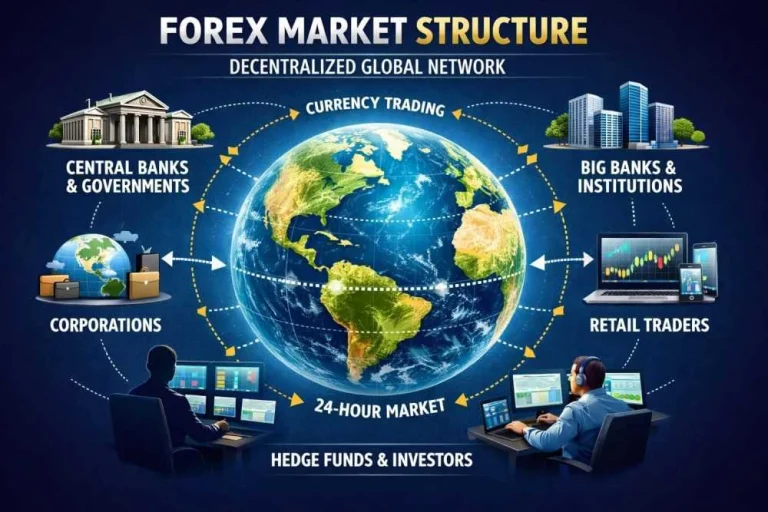
Banks, corporations, governments, investment funds, and eventually retail traders all began participating in this global marketplace.
Today, the Forex market operates electronically, allowing traders around the world to buy and sell currencies within seconds.
8. Why the Forex Market Never Sleeps
Unlike stock markets, the Forex market has no single central exchange.
Trading moves across major financial centres as each region begins its business day.
The market follows this general sequence:
- Sydney
- Tokyo
- London
- New York
As one market closes, another opens, creating a continuous trading cycle from Monday morning in Asia until Friday evening in New York.
This 24-hour nature is one of the reasons Forex has become the world’s largest and most liquid financial market.
⭐ Professional Trader’s Insight
Markets are built on confidence.
Throughout history, currencies have changed because economies, governments, and public confidence have changed.
Professional traders don’t simply study charts—they also understand the economic systems that drive long-term market behaviour.
Common Beginner Mistakes
❌ Thinking Forex was invented for online trading.
❌ Believing currency prices move randomly.
❌ Ignoring major historical events.
❌ Underestimating the role of central banks.
❌ Focusing only on technical analysis while ignoring economic fundamentals.
Chapter Summary
- Trade began through barter before money existed.
- Gold became the foundation of many early monetary systems.
- The Gold Standard stabilised currency values.
- Bretton Woods established the US Dollar as the world’s reserve currency.
- The end of Bretton Woods led to floating exchange rates.
- Today’s Forex market is driven by supply and demand across the global economy.
Homework
Before moving to Chapter 3:
- Search online for a timeline of the Gold Standard and Bretton Woods Agreement.
- Locate Sydney, Tokyo, London, and New York on a world map.
- Think about how global businesses benefit from the Forex market.
- Write a short paragraph explaining why floating exchange rates exist today.
Knowledge Check
- What trading system existed before money?
- What was the purpose of the Gold Standard?
- What was agreed at Bretton Woods?
- What happened in 1971?
- Why does the Forex market operate 24 hours a day?
Frequently Asked Questions
Why was the Gold Standard abandoned?
Because governments found it increasingly difficult to maintain fixed exchange rates while supporting growing economies and international trade.
What is the Bretton Woods Agreement?
An international monetary system established in 1944 that linked major currencies to the US Dollar, with the Dollar itself convertible into gold.
Frequently Asked Questions
Why was the Gold Standard abandoned?
Because governments found it increasingly difficult to maintain fixed exchange rates while supporting growing economies and international trade.
What is the Bretton Woods Agreement?
An international monetary system established in 1944 that linked major currencies to the US Dollar, with the Dollar itself convertible into gold.
What are floating exchange rates?
A system where currency values change according to supply and demand rather than being fixed by governments.
Why is history important for Forex traders?
History explains why the current monetary system exists and provides context for understanding economic events that influence currency prices.
Will currencies ever return to the Gold Standard?
While it is occasionally debated, the global financial system today is based on fiat currencies and floating exchange rates.
Continue Your Journey
- Chapter 1 – What is Forex Trading?
- Chapter 2 – The History of The Forex Market
- Chapter 3 – Currency Pairs
- Chapter 4 – How Forex Prices Move
- Chapter 5 – Reading Forex Quotes
- Chapter 6 – Pips, Points & Lot Sizes
- Chapter 7 – Leverage & Margin
- Chapter 8 – Types of Orders
- Chapter 9 – Bid, Ask & Spread
- Chapter 10 – Trading Sessions
Other Learning Lints:
- Forex Trading Automation OverviewPrevious Chapter
- AI Trading
- Algorithmic TradingNext Chapter
- Copy Trading
- Expert Advisor (EA)
- Gold Strategy
- Portfolio Automation
- Professional Trading Workflow
- Quantitative Trading
- Signal & Alert
- Trading Automation Roadmap
- Why Automate Trading
- Learn Forex
- Weekly Analysis
- Market Outlook
- Gold Outlook
- Blog