
Quantitative Trading
Learn how professional traders use data, statistics, backtesting, and automation to build systematic trading strategies.
Quantitative Trading
Discover how quantitative trading uses historical market data, statistical analysis, and backtesting to evaluate trading ideas before risking real money.
INTRODUCTION
What Is Quantitative Trading?
Quantitative Trading, often called Quant Trading, is the process of making trading decisions using data, statistics, mathematical models, and systematic analysis instead of emotions or intuition.
Rather than asking,
“I think Gold will go higher.”
a quantitative trader asks,
“Does historical market data show that this trading idea has produced consistent results over hundreds or thousands of trades?”
This data-driven approach helps traders build objective trading systems that can be tested, measured, improved, and eventually automated.
Today, quantitative trading is no longer limited to hedge funds or investment banks. With modern trading platforms, backtesting software, and programming tools, retail traders can also build quantitative strategies.
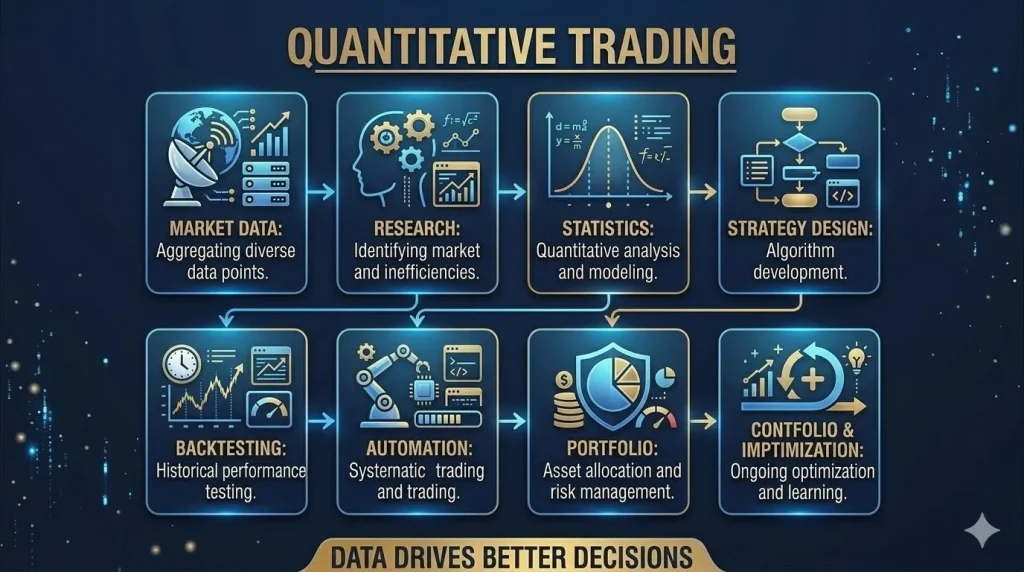
WHAT IS QUANT TRADING?
Quantitative trading combines several disciplines:
- Financial market knowledge
- Statistics
- Historical data analysis
- Risk management
- Programming
- Automation
- Continuous testing
The objective is simple:
Allow data—not emotions—to guide trading decisions.
HOW QUANT TRADING WORKS

Step 1 – Collect Data
Gather historical market data such as:
- Price history
- Volume
- Volatility
- Economic events
- Technical indicators
Reliable data forms the foundation of every quantitative strategy.
Step 2 – Research Ideas
Develop trading hypotheses.
Examples:
- Does Gold trend after breaking the previous day’s high?
- Does the London session produce stronger trends?
- Does an EMA crossover outperform a moving average pullback?
Every idea should be testable.
Step 3 – Backtest
Evaluate the strategy using historical data.
Measure:
- Win Rate
- Profit Factor
- Drawdown
- Average Return
- Number of Trades
- Risk-to-Reward Ratio
Backtesting helps determine whether a trading idea has shown positive results over time.
Step 4 – Optimise Carefully
Fine-tune strategy parameters without overfitting.
Examples:
- EMA periods
- Stop-loss distance
- Position sizing
- Entry filters
Avoid optimising solely to fit past data.
Step 5 – Forward Test
Test the strategy on a demo account or with a small live account to observe real-time performance before increasing capital.
Step 6 – Automate
Once the strategy has demonstrated consistent performance, it can be automated using:
- Expert Advisors
- Python
- APIs
- TradingView Alerts
- Algorithmic execution
Automation improves consistency by executing predefined rules without emotional interference.
Step 7 – Monitor and Improve
Markets evolve.
Professional quantitative traders continuously:
- Review performance
- Analyse new data
- Improve strategies
- Adjust risk
- Remove underperforming systems
Quant trading is an ongoing process of research and refinement.
WHY QUANT TRADING IS DIFFERENT
WHY QUANT TRADING IS DIFFERENT
Data-Driven Decisions
Every trading decision is supported by measurable evidence rather than intuition.
Objective Testing
Strategies are evaluated using historical market data before being traded live.
Continuous Improvement
Performance is monitored, measured, and refined over time.
Better Risk Management
Risk is analysed using statistics such as drawdown, volatility, and position sizing.
Automation Ready
Well-defined quantitative strategies can be converted into Expert Advisors or algorithmic trading systems.
Scalable Approach
Multiple strategies can be researched, tested, and managed within a diversified trading portfolio.
PRACTICAL USES OF AI FOR RETAIL TRADERS
ESSENTIAL TOOLS FOR QUANT TRADERS
Historical Market Data
Quality data is the foundation of reliable research.
Backtesting Software
Evaluate strategies using historical price movements.
Spreadsheet Software
Organise, analyse, and visualise trading performance.
Programming Languages
Python, MQL4, MQL5, and Pine Script are commonly used for developing trading systems.
Trading Journal
Record results and identify opportunities for improvement.
Portfolio Analytics
Measure the combined performance of multiple trading strategies.
COMMON MISTAKES
❌ Believing more indicators automatically improve a strategy.
❌ Overfitting a strategy to historical data.
❌ Ignoring transaction costs and spreads.
❌ Changing parameters after every losing trade.
❌ Using poor-quality historical data.
❌ Focusing only on profit while ignoring drawdown.
WHO SHOULD USE AI?
Curious Beginners
Understand how data supports better trading decisions.
Manual Traders
Validate trading ideas before risking real money.
EA Developers
Transform proven strategies into automated trading systems.
Professional Traders
Build diversified portfolios of systematic trading strategies.
FAQ
Do I need to be good at mathematics?
No. Basic statistics and logical thinking are sufficient to begin. More advanced mathematical concepts can be learned gradually as your skills develop.
Is programming required?
Programming is helpful but not mandatory at the beginning. Many traders start by using spreadsheets and visual backtesting tools before learning languages such as Python or MQL.
Can retail traders use Quant Trading?
Yes. Modern platforms have made quantitative trading accessible to individual traders with modest resources.
Is Quant Trading better than discretionary trading?
Neither approach is inherently superior. Many successful traders combine quantitative research with discretionary market analysis.
Does Quant Trading guarantee profits?
No. Quantitative trading improves decision-making through data and testing, but all trading involves risk and uncertainty.
RELATED RESOURCES
Continue Learning
→ Forex Academy
→ Algorithmic Trading
→ AI Trading
→ Expert Advisors
→ Professional Trading Workflow
FREE DOWNLOAD
Quant Trading Starter Kit
Inside:
✔ Strategy Research Template
✔ Backtesting Checklist
✔ Trade Statistics Worksheet
✔ Performance Dashboard
✔ Continuous Improvement Planner
Button
Download Free Starter Kit
Build Trading Decisions on Evidence, Not Emotion
Quantitative trading is not about finding a secret formula.
It is about asking better questions, testing ideas objectively, and allowing data to guide your decisions.
Whether you trade manually or automatically, adopting a quantitative mindset can help you become a more disciplined and consistent trader.
The journey begins with curiosity, careful testing, and continuous learning.
Buttons
NTERNAL LINKS
Previous
Next
Related
- Trading Automation Overview
- Algorithmic Trading
- Copy Trading
- Weekly Gold Outlook
- Blog
Ready to Explore Copy Trading?
If you’re ready to apply what you’ve learned, the next step is to explore a broker that offers Copy Trading features.
When choosing any broker, consider:
- Regulation and reputation
- Transparent trading conditions
- Platform stability
- Available Copy Trading features
- Risk management tools
- Quality customer support